
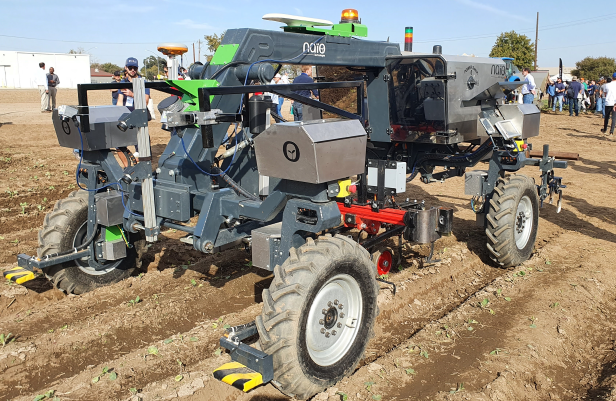

In a spirit of curiosity and in need of an adventure after the confinements of the last two years I took flight to California for a bit of October sunshine to visit FIRAUSA2022 to see the latest display of Californian Agricultural Robotics. Last year I managed to navigate Covid restrictions to visit FIRA2021 in Toulouse and my blog report of that meeting is here.
FIRA USA 2022 was held in Fresno a modern city of half a million at the Southern end of Central Valley region of California which is one of the great growing areas of the world where with irrigation water from the mountains pretty much anything can be grown. At the airport one is greeted with Welcome to Fresno, agricultural capital of the world.
The meeting was enjoyed by 1000 + delegates in a three day mix of R&D results, commercial interactions and most interestingly field demonstrations in salad crops and vineyards.
Being California there was huge enthusiasm to invest in the new wave of technology based on autonomous robotics, image processing and precision navigation. I think the investment crowd may have been a little disappointed as various company founders expressed views that suggested company growth should be organic and that VC money was not always appropriate as rapid scaling of agritechnology and early exits were unlikely.
The main interest was in systems that address the key problem in horticulture and viticulture of labour shortage. Even Mexican growers present were complaining that there is a labour shortage there. So weeding by hoes, spot spraying or lasers were the most viewed systems along with sub systems suppliers for navigation, wifi charging or image processing etc,
Most of the blade weeders were relatively simple, agitating a blade to swipe a weed identified by image processing as not the crop. One company FarmWise had build a full autonomous vehicle to weed which begs the question why not just mount it on a tractor and apply navigation and autoturn controls such as those offered by several manufacturers now.
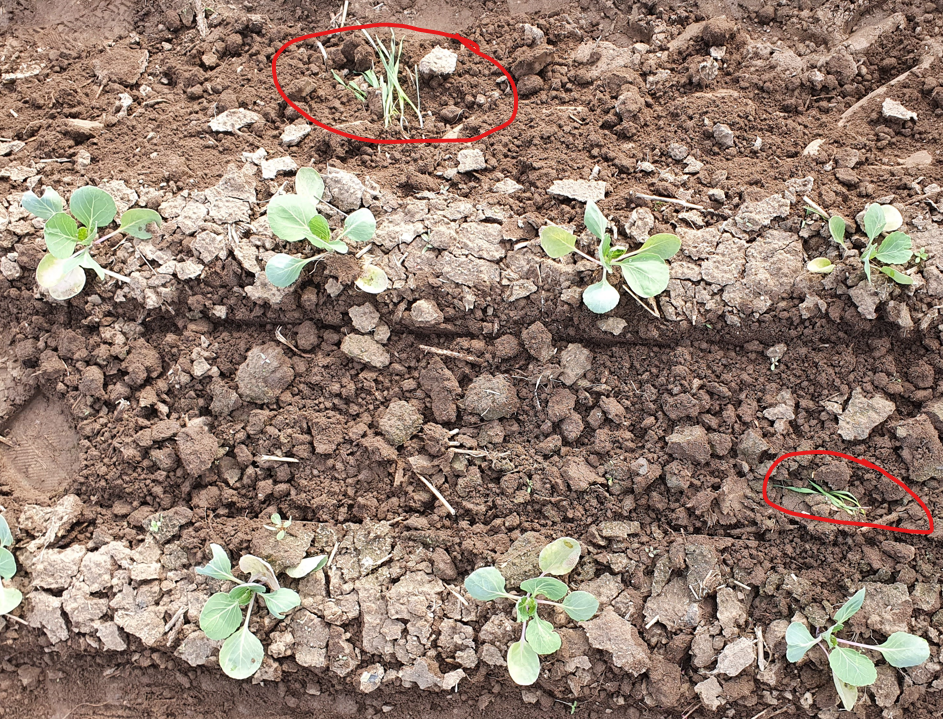
To me all the blade weeders looked primitive in comparison to the Garford Robocrop invented by Nick Tillet and Tony Hague 20 years ago and this was also pointed out by one of the scientific speakers.
More exciting was the laser weeder that could operate in beds of very small seedlings as it could burn out out weeds with pinpoint accuracy.
There were a lot of interesting panel discussions and science presentations and one I caught said that blade weeders were over 90% effective weeding between lettuce plants in rows although timing is critical. In Arugula (Rocket in UK) where plants are grown in beds timing is even more critical and there a laser weeder came out very well. You can see it working in the video . I walked down the bed after the machine finished and saw only two weeds in 100 metres. Both were emerging contiguous to the Rocket seedling which would need a finger weeding if a human was doing it.
There was a lot of attention on viticulture robots mostly for spraying which is obviously a major operation. See the video for a view of some of them. My favourite machine is the Swarmfarm system which was not able to make the journey from Australia where a number of them are busy. They are basically a metal frame, a diesel power source, navigation and autosteer. The video demonstration is well worth watching. I spoke to Andrew Bates the founder and he said he has a couple coming to UK soon.
There was considerable discussion about whether legislation will hamper the deployment of autonomous robots on farms. No-one wants a farm worker or child hurt by a robot although scaring off ramblers and crop circlers might be acceptable.
The Californian equivalent of HSE have recently judged that fully autonomous tractors must be supervised by a human and this has dealt a major blow to progress on autonomy.
This maybe a hurdle we need to jump in the UK fairly soon as autonomous tractors are working at a number of farms in test conditions.
